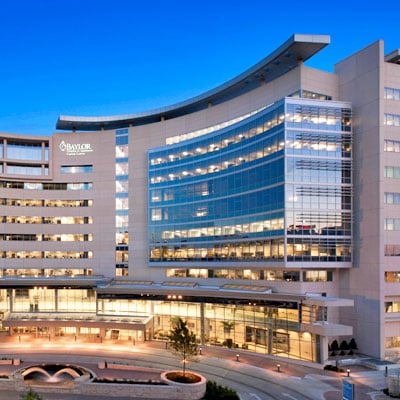
We provide expert gastroenterology care for patients with complex esophageal disorders

Baylor Scott & White Center for Esophageal Diseases is a specialized outpatient gastroenterology practice in Dallas focusing on esophageal disorders at Baylor University Medical Center, part of Baylor Scott & White Health.

Our center provides advanced care with a multidisciplinary team approach all while also conducting innovative research and participating in education at local, regional and national levels. Our providers are experts in the following esophageal disorders treatment:

  • Achalasia and other motility disorders
  • Barrett's esophagus
  • Difficulty with swallowing
  • Eosinophilic esophagitis
  • Erosive esophagitis
  • Esophageal strictures and narrowing
  • Gastroesophageal reflux disease (GERD)
  • Superficial esophageal cancer
Group photo of Baylor Scott & White Center for Esophageal Diseases providers
Baylor Scott & White Center for Esophageal Diseases

3434 Swiss Ave Ste 200, Dallas, TX, 75204

Not accepting walk-ins

Insurances accepted

Baylor Scott & White has established agreements with several types of insurance to ensure your health needs are covered.

Loading...
Loading

Diagnostic services

​​​​​​​​​​​​​Baylor Scott & White Center for Esophageal Diseases offers testing, endoscopic services and minimally invasive surgery for esophageal diseases in Dallas.

Colonoscopy

A colonoscopy is an endoscopic procedure to examine the inner lining of your large intestine, rectum and colon.

A thin, flexible tube called a colonoscope is inserted into the rectum and steered through the colon by the physician to look at the lining for any abnormalities.

Biopsies may be performed to sample the tissue.

If identified, polyps may be removed through the scope.

Therapeutic services

Baylor Scott & White Center for Esophageal Diseases in Dallas offers therapeutic procedures for esophageal diseases.

Anti-reflux surgery/fundoplication

A surgical fundoplication is a surgical procedure to provide additional support the to lower esophageal muscles to reduce fluid from coming up from the stomach into the esophagus.

It is considered in some patients with acid reflux disease.

The surgeon wraps the top portion of the stomach around the junction of the esophagus and the stomach to reduce the reflux of contents back into the esophagus.

Pay bill

Baylor Scott & White Health is pleased to offer you multiple options to pay your bill. View our guide to understand your Baylor Scott & White billing statement.

We offer two online payment options:

Other Payment options: 

Financial assistance

At Baylor Scott & White Health, we want to be a resource for you and your family. Our team of customer service representatives and financial counselors are here to help you find financial solutions that can help cover your cost of care. We encourage you to speak to a team member before, during or after care is received.

View financial assistance options

Patient forms

To ensure that your visit to our office is as convenient and efficient as possible, we are pleased to offer our registration forms online. The patient registration form may be completed electronically and printed for better legibility or completed manually.

Other helpful information

Research

The Center for Esophageal Research is devoted to conducting innovative, translational research in a multidisciplinary setting in order to advance understanding of esophageal diseases and to improve the treatment of patients with those diseases.

Focus areas of translational research within the Center For Esophageal Research in Dallas include:

  • Advanced endoscopic imaging of esophageal diseases
  • Barrett’s esophagus
  • Eosinophilic esophagitis
  • Esophageal adenocarcinoma
  • Esophageal squamous cell carcinoma
  • Gastroesophageal junction adenocarcinoma
  • Reflux esophagitis/gastroesophageal reflux disease (GERD)/non-erosive reflux disease (NERD)
  • Swallowing disorders

Dr. Souza discussing how aspirin may help prevent Barrett's esophagus

Dr. Souza in the lab

Coordinators

Clinical studies coordinator
Daniel Kim

Histopathology coordinator
Elizabeth Cook, H.T. (ASCP)